
InterDigital, Inc (IDCC US)
Amazon Converts SCS from Optionality into Reported Revenue
Disclaimer: Below is a summary only. Full analysis in the PDF.
Long (PT: $700)
The First Material SCS Revenue Has Arrived
InterDigital’s Q2 2026 results provided further evidence of the attractive underlying characteristics of the business. Annualised Recurring Revenue reached an all-time high of approximately $626 million, up 13% year-on-year, while the Q2 adjusted EBITDA margin reached 71%. Management also raised every line of its FY2026 guidance at the midpoint.
What prompted this follow-up, however, was the milestone reached within Streaming & Cloud Services (“SCS”).
In June, InterDigital and Amazon agreed to enter into a patent licence covering Amazon services and devices, including Prime Video. The parties resolved the pending litigation path and agreed to submit the remaining licence terms, including its ultimate value, to binding arbitration.
Alongside the agreement, InterDigital reported $110 million of Q2 SCS revenue. This comprised $95 million of catch-up revenue and $15 million of current-quarter recurring revenue, mechanically equivalent to $60 million of programme-level ARR.
This is the first material, separately disclosed revenue recognition within SCS. More importantly, it establishes that one of the world’s largest video platforms has agreed to enter into a licence covering InterDigital’s technology. SCS monetisation is therefore no longer merely theoretical.
Why the Initial $60 Million May Not Be the Final Number
The reported $60 million of ARR is not a disclosure of the final Amazon royalty. Nor should it be interpreted as an Amazon-only figure: InterDigital reports it at the SCS programme level.
Because arbitration has not yet determined all the commercial terms, InterDigital has recognised revenue using a constrained estimate under ASC 606. The accounting standard permits management to estimate the consideration it expects to receive, but only to the extent that a subsequent change is not expected to cause a significant reversal of cumulative revenue.
Table 1 – Management’s Described Amazon Accounting Sequence

Management expressly characterised the current estimate as conservative. CFO Richard Brezski also said that any eventual adjustment was “more likely to increase rather than reduce recognized revenue.”
This creates the possibility of two forms of future upside:
A retrospective true-up for revenue attributable to earlier reporting periods; and
A higher prospective recurring run-rate once the final terms are established.
That asymmetry is important, but it is not a guaranteed accounting floor. The estimate can still be revised downward, and the arbitration panel remains responsible for determining the final economics.
The Samsung Parallel
Samsung provides the most relevant public illustration of how this accounting mechanism can operate in practice.
When InterDigital and Samsung entered into a renewed licence in January 2023, the final economics were left to ICC arbitration. During that process, InterDigital recognised approximately $78 million of annual revenue, broadly consistent with the expired agreement and described as a conservative estimate.
The tribunal ultimately awarded $1.05 billion across an eight-year licence term. This implied approximately $131 million of annual recurring revenue, 67% above the constrained amount recognised during arbitration. InterDigital subsequently booked approximately $119 million of catch-up revenue and reset the prospective recurring run-rate.
Samsung does not provide a formula for Amazon. The agreements cover different products, technologies, territories and commercial scopes, and Samsung has subsequently challenged the determined royalties. It nevertheless demonstrates that conservative recognition during arbitration can materially understate both the eventual historical catch-up and the recurring run-rate.
Disney Is the Next Commercial Test
The most important next-order implication is Disney.
InterDigital has secured multiple injunctions against Disney, including two Unified Patent Court decisions covering 11 European countries. Enforcement has also become visible to Disney+ customers: media reports indicate that Disney initially withdrew certain 4K and HDR functionality before partially restoring 4K through an alternative technical route. That workaround reduces the immediate pressure, but device coverage remains incomplete and the underlying legal disputes continue.
The near-term catalyst calendar now includes a Delaware antitrust motions hearing scheduled for 28 August and a further Düsseldorf UPC decision expected in September.
Table 2 – Near-Term Disney Catalyst Calendar
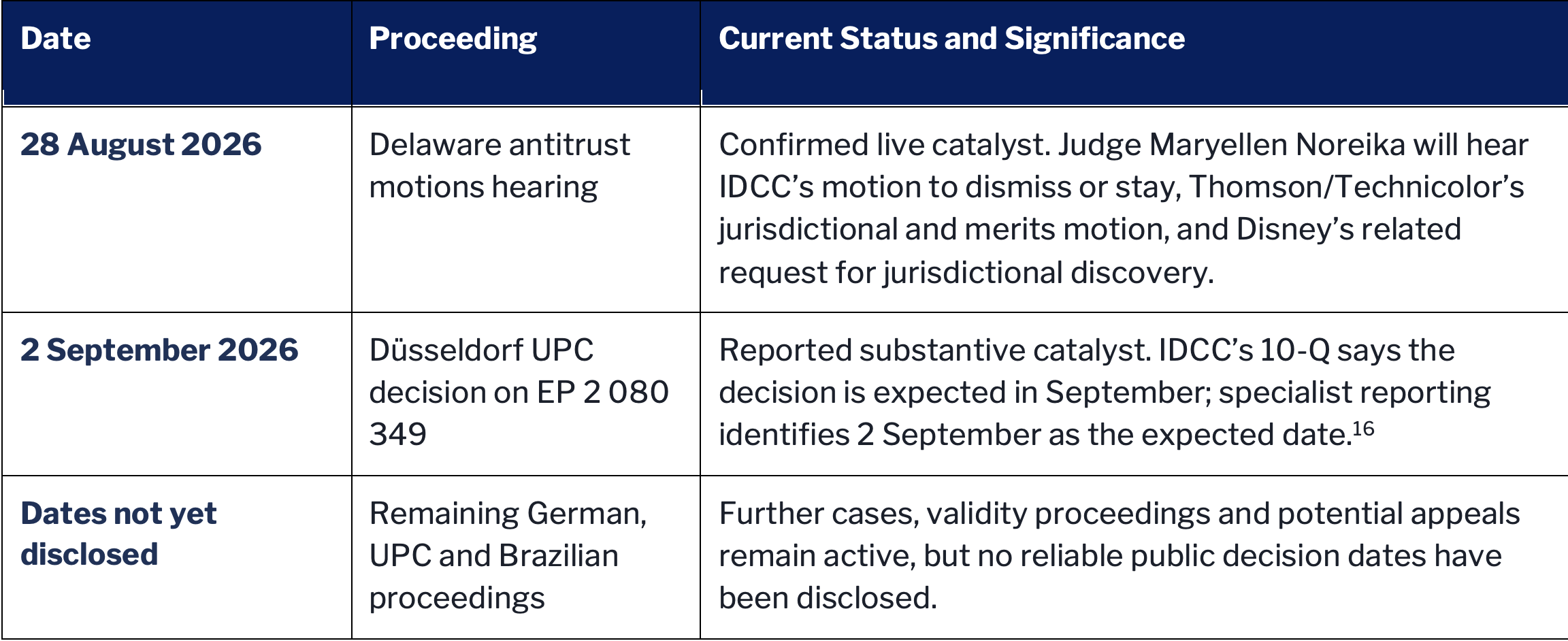
These proceedings increase the probability of an eventual Disney licence, but they do not create a hard settlement deadline. Disney retains potential appeals, validity challenges and further technical workarounds. The California patent case has also been stayed, removing two previously anticipated August and September pressure points.
The significance of Amazon is that it establishes a credible alternative route: a major streaming platform can take a licence, end global litigation and leave the final economics to an independent tribunal. Disney could ultimately follow a similar structure, although there is no assurance that it will do so.
What This Means for Our Projections
Our February 2026 report forecast $120 million of Q2 SCS revenue, comprising $100 million of catch-up revenue and a recurring run-rate equivalent to $80 million of ARR. The eventual result—$110 million in total revenue, including $95 million of catch-up and a $60 million programme run-rate—was close to our original ballpark, although Amazon rather than Disney was the first counterparty to convert.
Exhibit 1 – SCS Financial Projections

We continue to forecast approximately $165 million of recurring SCS revenue in FY2027 and $247 million in FY2028.
At a mature run-rate, approximately $100 million from Amazon and $65 million from Disney could support our FY2027 figure. The timing of recognised revenue will, however, depend on when those economics become effective. FY2028 requires the programme to broaden further and assumes another substantial streaming, device or cloud licence.
This is consistent with management’s ambition to generate more than $300 million of SCS ARR by 2030. Our forecasts imply that InterDigital could approach that level earlier, although the precise timing of individual agreements remains uncertain.
Our View from Here
Amazon has moved SCS from largely unrecognised optionality into material reported revenue. The agreement provides a commercial proof point, a framework for resolving global licensing disputes and a tangible reference point for negotiations with other platforms.
The thesis is not complete. Amazon’s final economics remain subject to arbitration, Disney continues to litigate, and alternative codecs and technical workarounds represent genuine risks. FY2028 also requires another meaningful licence beyond Amazon and Disney.
Exhibit 2 – Valuation Sensitivity Table - Implied IDCC Ex SCS 2026 P/E

Nevertheless, the developments materially strengthen our conviction that SCS can become a substantial, high-margin recurring revenue stream. Against that backdrop, we retain our $700 per share base-case valuation.